Friday, November 30, 2012

Bioenergetics and photosynthesis intro


Thursday November 29th 
What are the Reactants (inputs) of Photosynthesis?
Sunlight, Carbon Dioxide and Water 
What are the reactants (inputs) of cellular respiration?
Glucose and Oxgyen 
How are the inputs and outputs of cellular respiration and photosynthesis related?
The inputs (reactants) of cellular respiration are the outputs (products) of photosynthesis.


Friday November 30th
For every cycle of photosynthesis how many Carbon Dioxide molecules are needed?
 6
One of the main products of photosynthesis is glucose, how many carbons does glucose have?
 6
What can we infer about WHERE the carbon comes from to make glucose?
The carbon found in glucose ultimately comes from Carbon Dioxide from the atmosphere.

Over the past two days we started looking at the notes specifically on photosynthesis.  We also looked at a couple different videos.  The first two were meant to motivate you..... or something like that!  the famoeous "Photosynthesis Rap"  Found below
 Then the more "light hearted" song
And then finally today I had you look at the following khan academy video that will b a good reference for if you miss any of the next couple days!

Tuesday, November 27, 2012

Bioenergetics introduction

I hope you guys all enjoyed your Thanksgiving break.  Only 16 more school days until Christmas!!!!   Last week we took our cell membrane/ cell transport exam on Monday and did some extra credit on tuesday with some scientific readings on the myth of tryptophan.  This week we start into a new chapter on bioenergetics.  These are the following Keystone Exam Anchors we will be focusing on for the next couple weeks.


Today's daily questions served as a review of what you have learned about bioenergetics throughout previous years.  We will be moving into MUCH more detail than you learned before, but most of you were able to answer almost all of these based on previous knowledge!
Tuesday November 27th
Ultimately, all the energy that we have originates from where? The Sun
What is the name of the process that turns energy from this into chemical energy?Photosynthesis
What macromolecule is our MAIN source of energy? Glucose
            What molecule is that then turned into for our cells to use? ATP!!!
After this we started into introductory notes on the energy of life - please check out Edline if you missed any of these!!

Wednesday, November 14, 2012

Endocytosis and Exocytosis

Wednesday November 14th 
#2 ATP

What form of transport would this be considered?  Active Transport (Since molecules are moving from an area of LOW concentration to HIGH concentration this would be ACTIVE transport and require energy in the form of ATP)

Give one example of this type of transport in human cells. The Sodium-Potassium Pump.  This pumps positively charged ions AGAINST their concentration gradient setting up a concentration gradient which creates an electrochemical gradient.  This allows nerve signals to be sent and aids in water balance inside of cells.

After these questions we finished up notes on active transport focusing on Endo and Exocytosis.  Below are some of the clips i showed to let you see how this works in our bodies and those of single celled organisms.
Other places to show animations of active transport are below

Animations of ALL type of cell transport can be found here

Monday, November 12, 2012

Day 4 and Wrap Up

Friday we finished up the egg lab and had some fun with our "bouncy" egg.  In the mean time though, we continued through notes about osmosis. Here were some pics from the lab
Many of you attempted to "bounce" the egg
that was now full of water
Looking MUCH different than yesterday!!

And the best part of all - disposing of the eggs!
Today then we started with the following daily question:


Because water moves from an area of high concentration to low concentration, water will move OUT of the cell.  Since the solute concentration is higher outside of the cell than in - it is considered to be a hypertonic solution.  The cell would shrink in this type of solution.


We then finished up the osmosis notes and examples and you then had time to finish up your egg lab and application questions.
Some demonstrations I did to show you how most cell
are made up of a TON of water (like this water balloon)

The cells are suspended in fluid and when the concentration
of water is different inside the cell then outside the cell
water moves across the membrane and this is known as osmosis

Thursday, November 8, 2012

Day 3 of Egg Lab

Today you took your egg out of the corn syrup
You measured the corn syrup and noticed that there
was more liquid in there than you added yesterday


The EGG on the other hand looked a little well......
deflated!!!

After this you then placed the egg into water. I lead you in a discussion from your notes about facilitated diffusion and osmosis. Please Check edline for the notes!

Day 2 of Egg Lab

Yesterday you took your eggs ouf of the vinegar, weighed them and measured a final volume left in the beaker.  You noticed that the egg weighed more and the there was less vinegar in the beaker than when you left it yesterday.  This was letting you see diffusion in action!  You had the fun opportunity to take the shell off the eggs and 2 of you managed to break your egg..... sorry about that guys!!!

Here were some pics from today.

egg out of vinegar

Taking the shell off the egg


shell completely off egg


Ooops!!!!
"I didn't MEAN to!!!  I was just Holding it and
it broke!!!"

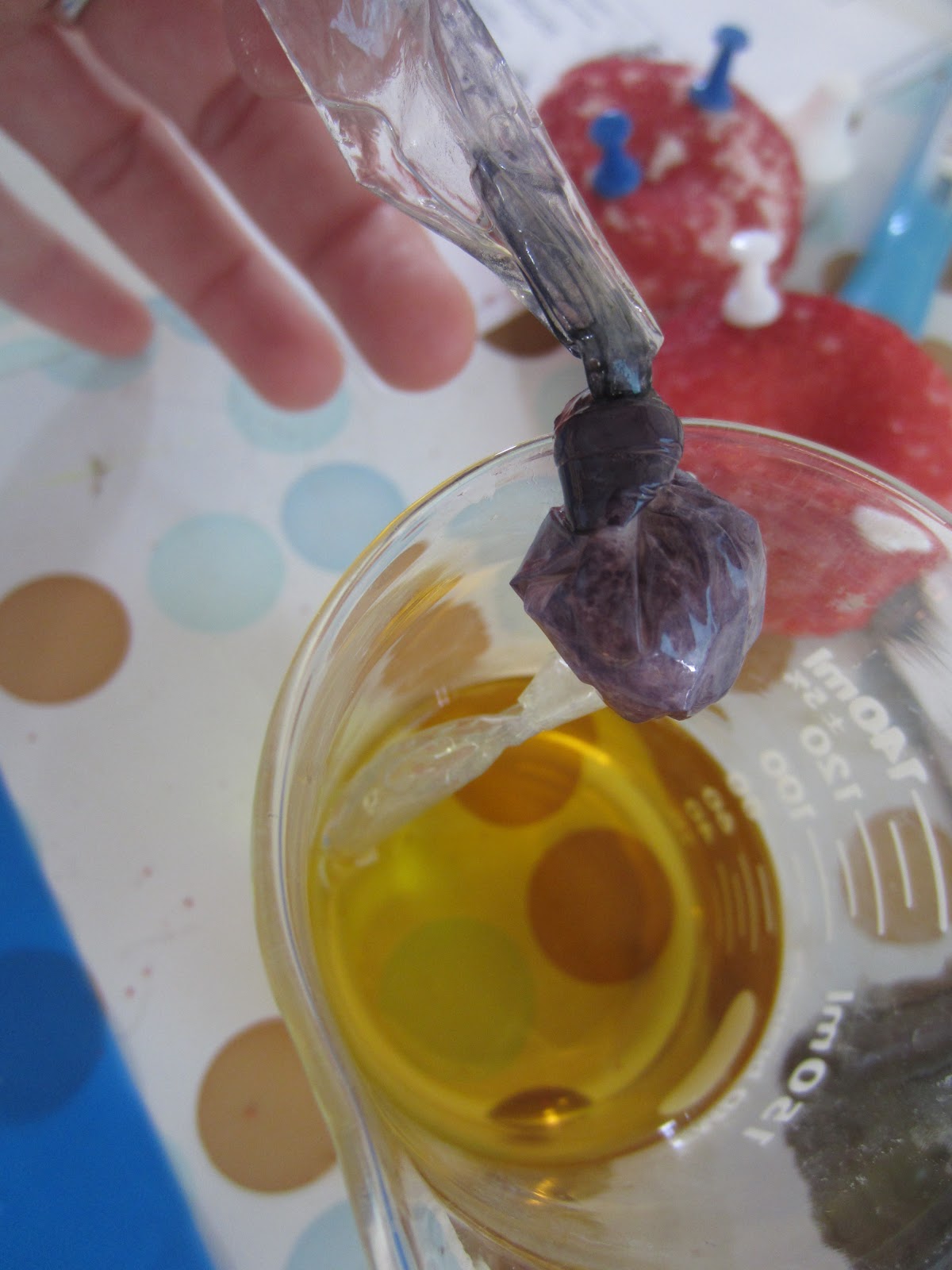
I also showed you how Iodine moved into a cell membrane.  Below is an image of a bag full of corn starch.  In just water it remains white.  When placed in iodine - the iodine molecules were able to move across the membrane into the bag.  We know this because the corn starch turned a bluish black color.  In the presence of iodine complex carbohydrates turn this color.
Bag in water
Bag once placed in iodine

Tuesday, November 6, 2012

Day 1 of Egg Lab!!

We started with a review of the cell membrane and an intro to passive transport with the following DQ's

Tuesday November 6th
I have type A blood.  What part of the cell membrane surrounding my red blood cells determines that I have type A blood!!!
Red blood cell with no "tags"
Type O blood
Cell Surface Markers (Also known as Glycoproteins)

Red blood cell with "A"
tags = Type A blood

Red Blood cell with "B" Tags
= Type B bloo

Red Blood Cells with Both
A and B tags = Type AB blood


TSH (Thyroid Stimulating hormone) binds to thyroid cells and initiates the production of T3 and T4 (Thyroid hormones), what part of the cell membrane does TSH bind to?
Receptor Proteins

When molecules move – they generally will move from an area of High to Low concentration until the concentration is equal everywhere.  Once this has occurred it is known as Dynamic Equilibrium.
What is happening to the molecules at that point (in terms of movement)The molecules are constantly moving randomly (In no NET direction)

After this we started into our Egg lab!!  Today you just weighed your egg, named your egg and put it into Vinegar!  I had you answer some pre-lab questions and make predictions of what you think may happen over night. 
You Weighed your Egg

Then measured out 100 ml of vinegar 


Then Carefully placed your egg into the vinegar!

And some of you then drew pictures.............  Nice
art work Carter ;)
Tomorrow we will see what happened and how this all relates to cell transport AND the structure of the cell membrane!!

Monday, November 5, 2012

Cell Membrane Discussion


Monday November 5th
The cell membrane is made up of a bilayer made of two parts
1. Polar Phoshpate heads which are attracted to water (Hydrophilic)

2.  NonPolar Fatty Acid (lipid) Tails which are repelled by water (Hydrophobic)

Because of this, what kind of molecules can pass freely through the cell membrane? Small nonpolar molecules such as oxygen, carbon dioxide and natural steroid hormones.

Other substances (larger/polar molecules) move through membrane proteins known as  Transport Proteins (Channel and carrier proteins)

I discussed all the notes on the cell membrane and we started to get into the notes on passive transport.  We will start a lab tomorrow looking at different types of passive transport.  One demonstration I did today showed you what BASIC diffusion is and what the term "Dynamic Equilibrium" means.  The following are pics of red dye diffusing through a test tube.  This was an example of simple diffusion.  We will be looking at much more complex forms of transport throughout this week and next!

Red Dye added initially

A concentration Gradient has now formed with a high concentration
at the top and a low concentration at the bottom.

The Dye continues to sink, still setting up a concentration gradient

The Dye has now sunk to the bottom and will now
move from an area of HIGH concentration to an area of LOW
Concentration.

Red dye molecules continue to move WITH
the concentration gradient.

At this point, the test tube would be in Dynamic Equilibrium.
It is NOT that the molecules have STOPPED moving, it is
that now they have no NET movement.  

Thursday, November 1, 2012

Thank You

You guys have been GREAT over the last two days since I have lost my voice so for that
Alright,  So just as a reminder of what we have done - you have stared reading through this chapter in the book and filling out the directed reading.  Tomorrow I will have you get down all the passive transport notes and I am hoping that my voice will be back by Monday when we will discuss all the notes and start into our a SWEET lab about passive transport!

Saturday, October 27, 2012

What's coming up next in the world of bio?!?!?!

The next chapter we will be going through is on the structure/function of the cell membrane and cellular transport.  Here are the areas of the keystone exam we will be covering
To get a sneak peak at this weeks content - check out the video below.


Tuesday, October 23, 2012

Monday and Tuesday Daily Questions


 Daily Questions 
Monday October 22nd
I look under a microscope and see rigid cell walls and green structures inside cells.  Because of this what can I infer about the cell?
 That it is most likely a plant cell.  Just the presence of a cell wall does not automatically make it a plant cell because bacteria also have cell walls.  The presence of the chloroplast does that indicate that it is a plant cell.

Some disorders are caused by a lack of lysosomes in the cells of a particular tissue, what would result from this? (what would happen in the cell?)
 Since lysosomes aid in breaking down cellular "junk" and removing it from the cell the lack of those would cause a build up of wastes and the cell would become "toxic"

If the golgi apparatus was out of order in a cell, what would the direct result of that be regarding protein production and transportation?

Since the golgi apparatus is responsible for putting finishing touches on proteins that were made in the rough endoplasmic reticulum, it these were out of order protein that were meant to be shipped out of the cell would not.

Tuesday October 23rd
A Scientist observed a protein that had been processed in the endoplasmic reticulum of a cell and then entered the cytoplasm.  Where will the protein most likely go next?
       A. It will move to a ribosomes that will release it outside the cell
     B.   It will move to a ribosomes to be packaged in a vesicle for transport
     C.   It will move to a golgi apparatus that will then release it outside the cell
       D.  It will move to a golgi apparatus to be packaged in a vesicle for transport
Which statement BEST describes the role that is common to chloroplasts and mitochondria in plant cells?
     A.The both use light to produce energy
      B They both are involved in protein synthesis
     C.They both convert organic compounds into ATP
     D. They both are involved in energy transformations
Which structure and function are common to both prokaryotes and eukaryotes?
     A.Mitochondria that generate usable energy for the cell
     B.Mitochondria that control what enters and exits the cell
     C. A cell membrane that generates usable energy for a cell
    D. A cell membrane that controls what enters and exits a cell
Ribosomal subunits made of protein and Ribosomal RNA are assembled within the nucleus.  To which organelle will these ribosomal subunits MOST LIKELY be transported?
    A.Vacuole      B.  Mitochondria      C.  Golgi apparatus       D.  Endoplasmic Reticulum
Which feature is common to all prokaryotic and eukaryotic organisms?
a. Endoplasmic reticulum that stores fat reserves
b. Ribosomes that produce complex carbohydrates
c. Nucleic acids that code for genetic characteristics
d. Mitochondria that are sites for cellular respiration.

Thursday, October 18, 2012

Organelles Wrap Up

We started with daily questions from older material (on the introduction to cells and the cell theory)
Thursday October 18th

The cell is the basic unit of Structure & Function in all living organisms.
The human body has about 200 different types of cells with VERY different functions.  What determines the function of a liver cell compared to a kidney cell? The structure of the cell.  Remember, all cells have similar structures found in them but they look incredibly different because they have incredibly different functions.  Below are some pictures of different eukaryotic cells.
Liver Cells


Kidney Cells
Lung Cells
 See how each of these cells have VERY different strcutres because they have VERY different functions!!


The main difference between prokaryotic and eukaryotic cells is the presence or absence of what? A nucleus.  The term prokaryotic literally means "Before Nucleus" or "Before Kernel" because have no nucleus and they are much more primitive than Eukaryotic cells.  Eukaryotic literally means "True Kernel/Nucleus" because it DOES contain a nucleus.What are three features of a cell that are common to both prokaryotic and eukaryotic cells?While prokaryotic and eukaryotic cells are very different, they ALL contain DNA, are enclosed in a cell membrane, are filled with cytoplasm and contain ribosomes

After this we had a brief discussion on the organelles and we answer the following two questions together as a class.

The structures found in a living cell can be compared to the parts of a factory that produces cars. Which part of the factory is most similar to the nucleus of a living cell?
(1) a conveyor belt that transports materials (Incorrect - that would describe either the endoplasmic reticulum or the golgi apparatus which transports proteins)
(2) a storage bin that holds the pieces needed to assemble a car (Incorrect - that would by the vacuoles)
(3) the computer room that controls the assembly process - Correct!!!  Since the Nucleus stores the DNA, it basically is in charge of EVERYTHING that happens in the cell!
(4) the generator that provides energy for the factory (incorrect - The generator would be the mitochondria which converts organic molecules into usable energy.)

Certain poisons are toxic to organisms because they interfere with the function of enzymes in mitochondria. This results directly in the inability of the cell to
(1)  store information (Nope - information is store in the nucleus)
(2)  build proteins (Nope - Proteins are built in the ribosomes)
(3)  release energy from nutrients (DING DING DING!!! That is correct!)
(4)  dispose of metabolic wastes (nope - that happens in the lysosomes!)
After this I passed out a worksheet that first made you match up organelles with their functions and then started to apply the function of those organelles with different disorders.  Using the examples I have done in class, i asked you to choose the correct answer AND tell me what is wrong about all the other statements!
DAILY QUESTION QUIZ TOMORROW!!!!!

Wednesday, October 17, 2012

Cell Structure and Function

Well it has been a WHILE since I have posted on here guys!!!  We are full force into our chapter on cell structure and function.  You have all the notes you need on the cell theory, the two types of cells (prokaryotic and Eukaryotic) as well as the different organelles and their functions.  We will spend a little more time going over these different organelles and how they all work together to make a cell run.

We did have daily questions today and last wednesday.


Wednesday October 17th

These groups of cells represent different
(1) tissues in which similar cells function together
(2) organs that help to carry out a specific life activity
(3) systems that are responsible for a specific life activity
(4) organelles that carry out different functions

Which sequence lists the levels of organization in the human body from simplest to most complex?
(1) organ system >tissue >cell >organ
(2) tissue >cell >organ >organ system
(3) organ >organ system >tissue >cell
(4) cell >tissue >organ >organ system

Tissue is composed of a group of
(1) similar cells working together
(2) different organs working together
(3) organ systems working together
(4) nuclei in a cell working together

Humans require organ systems to carry out life
processes. Single-celled organisms do not have
organ systems and yet they are able to carry out
life processes. This is because
(1)  human organ systems lack the organelles found in single-celled organisms
(2)  a human cell is more efficient than the cell of a single-celled organism
(3)  it is not necessary for single-celled organisms to maintain homeostasis
(4)  organelles present in single-celled organisms act in a manner similar to organ systems

Wednesday October 10th
If a cell is like a city, what part of the cell would be the: 
“control center” - The Nucleus
“Recycling Center” - The Lysosomes
“Post Office” - The Golgi Apparatus