If you decided to do the write up as your final - just a reminder that is due on Friday. If you are doing the write up only as a discussion on evolution and natural selection it is now due on THURSDAY (not tomorrow as originally stated)!!!
You received a review packet yesterday in class and continued to work through it today. Please take time looking at each section using it as a reminder of what we have learned so far. I also put last years bio 1 final on edline for your referance. Take a look at this to help you prepare for yours!!
A little background on the guppies. MALE guppies are the ones that are usually "pretty" or "Flashy" as they are trying to impress the females who are usually very "drab". There needs to be a balance though between being flashy to impress the ladies - but not TOOO flashy that all the predators are able to see you and therefore eat you. We ran through a couple scenarios for many generations to see what happened to the population. What we found was that in certain scenarios, the types of predators did not affect the population at all. Other times the brightest fish died off and only the drab survived. I encourage you to run through these scenarios and look at the results and the analysis which speaks of why
So far we have continued through the notes on Evolution/natural selection. I printed out the major forms of micro and macroevolution for you to give us some time to start into a project. I mentioned in class today that if I can get REAL creative, I will have your final be a paper based off the chapter I assigned you and how you can relate all that we have learned this semester with your chapter. The two books the chapters are taken from are below.
You have also received a "packet".... oh dreaded packet..... with questions based on this chapter. I encourage you to work through this at your own pace as this will mostly likely take the place of a test on this topic. I really would like you to work on showing how everything we have learned this semester molds so perfectly together!!! I will give you a detailed rubric to the project as soon as I get it typed!!!!
This week we started in to our LAST chapter :) :) :) on Evolution and Natural Selection. The daily questions we received Tuesday, Wednesday and Today are below. I know that you covered basics of evolution and natural selection last year but this year we will be applying our understanding of Genetics and gene expression to get a better understanding of how exactly allele frequencies change over time. Tuesday:
1. Which population of organisms would be in greatest danger of becoming extinct? ***A population of organisms having few variations living in an unstable environment. *Having little variation is not a good thing when a major environmental change occurs.
2. In order for a new species to develop, there must be a change in the **Genetic makeup of a population. (This can be DUE to a change in the temperature or migration patterns, but ultimately it comes down to a change in the allele frequencies of a population)
3. Which statement is NOT part of the concept of natural selection?
A. Individuals that possess the most favorable variations will have the best chance of reproducing.
B. Variation occurs among individuals in a population
C. More individuals are produced than will survive D. Genes of an individual adapt to a changing environment***GENES do not adapt - individuals adapt and populations adapt - but genes do not. They may "change" due to random mutations though.
** 2 - a decrease in the advantage of having white fur. Since over a 10 year period the presence of ANY white rabbits was eliminated, that most likely means that having white fur was no longer a good thing.
Which statement best describes a current understanding of natural selection? A. Natural Selection influences the frequency of an adaptation in a population.
We then started into the notes on Evolution and natural selection. Please check edline for these
Wednesday May 2nd
The
scientist who traveled to the Galapagos island’s was……… Charles Darwin
He
specifically looked at what type of organisms? Finches (along with many other interesting creatures!!)
True
or False: All Mutations are Bad FALSE!!! Mutations simply mean a change in DNA This can sometimes have an advantage, sometimes be bad, or other times have no affect on the phenotype. For instance, i showed you the clip about a child that was born with 6 fully functional fingers and toes (see Below)
True
or False: Not all mutations are
passed on to our offspring. TRUE - Only mutations that occur in germ line cells (those that will go through meiosis to become our gametes) will be passed on to our offpsring.
Thursday May 3rd
*What
did Darwin notice about the finches and what did that lead him to believe about
the “evolution” of them? He noticed that their beak shapes directly corresponded to the type of food they ate. What he theorized was that the finches has migrated from the main land of South America and overtime adapted to different food sources. He called this "Descent with modification"
*With
our understanding of genetics, these different “variations” are known as what? Alleles
*What
do you think caused these different variations? Mutations
*What
two types of variations do you believe would provide an “advantage” to a
species? Any allele that would allow them to survive (eat and not be eaten) and reproduce.
Today we continued with the notes and will next move into some chapters from the book Survival of the Sickest.
Today I gave you your tests back. You guys did pretty well on this. Second period had an 89% average score and 8th period had an 80% average - Both GREAT averages for such a complex topic so don't be too discouraged if you did not do as well as you had hoped. Since the next chapter springs RIGHT from this I felt is was worth the time going over each question with you to make sure that you understood how our genes effect our traits and how CHANGES in those genes ultimately lead to new characteristics.... Sometimes good, sometimes bad.... sometimes with no great effect.
As I often do on tests/quizes, I provided you wil the following sections of a writing by Marianne Williamson called "Our Deepest Fear." You guys got one of my "life lesson lectures" about how I see this tendancy in a LOT of you to downplay your own potential because that is "easy." It really is much easier to say.... "Oh.... don't ask me... I'm not smart, I'm not strong enough, I'm not fast enough.... etc" because that gets you out of actually living up to your potential!!!! It much scarier to think about what you are capable of doing!!! So if you remember NOTHING more about this class - I hope you remember that "you'r playing small" serves NO ONE!!!
There were a couple of you that still needed to present your slides so I had you do that. We started class with the following daily questions though. This is a good wrap up for mutations and how they affect not only the RNA sequence, but consequently the protein itself.
Wednesday
April 25th
In
a frameshift mutation, which would cause more harm to the protein the addition
on 1 nucleotide or the addition of 6 nucleotides?Why?
Adding just one - when adding nucleotides in sets of three you are just adding another amino acid instead of moving everything down (unless of course you add three in the middle of a codon)
*Mutations
such as missense and nonsense would occur during which of these processes?
** During DNA Replication or Transcription. These types of mutations are changes in the actual DNA or RNA sequence - therefore it could only happen when DNA or RNA is MADE. So during DNA replication if the DNA Polymerase doesn't do a good job of "proof-reading" that will change the DNA which then during transcription will be coded into mRNA with that same mistake.
*Mutations
such as translocation and nondisjunction would occur during which of those?
Meiosis - these are when crossing-over goes "Wrong" or when chromosomes do not fully separate from each other.
A couple last things then that I discussed. First, we have talked about mutations that have no effect (silent mutations) and those that cause LARGE changes in the protein shape that are harmful; but a key thing to understand is that some mutations are actually advantageous!! We will talk more about this in the next chapter and you will see how this all just flows together. If no mutations ever occurred then there would only really be two sets of genes that ALL of us had (from the first male/female). The word Mutation often times gets a bad wrap when really ANY change in the DNA is a mutation. So different alleles are just different "mutations" which ultimately give us the variety in traits that we have today.
Tomorrow will be our formal review - I have almost finished typing it up so feel free to check it out tonight but here is a run down of the content that we have covered this chapter.
All right. So we have made it through what DNA is and how we get from that crazy "snotty" stuff to our actual characteristics. We then looked at what happens when this "instruction manual" gets messed up. NOW...... if there are all these genes in EVERY single cell in our body..... WHY aren't all these proteins being made in every cell?!?! Remember, that comes down to cellular environment. Only certain genes are actually expressed (meaning they go through transcription and translation) in any given cell. What the human genome project did was look at EVERY SINGLE chromosome and determine the genes that are found on them. Here is a quick link to the image that is found in the back of the room.
The best way to see this is to actually zoom in on each chromosome and you will see what genetic disorders are associated with that region of the chromosome. BUT...... not every cell in the body would be affected by these since they are not being expressed in all cells.
Today I had you present your slides describing your specific mutation. Here are a couple examples!!
Overall I liked what I saw!! Check Edline and I will put together an overall mutations powerpoint with the details that I really wanted you to take away from this project!! We will finish that up tomorrow and start our review. I am still looking to have the test on Friday with our formal review on Thursday!!
Today I gave you some time to finish up your slides on mutations. Tomorrow you will present them and I will make sure to let you know of any missed information from these slides. We will be wrapping this up and will have the test on this chapter by Friday.
Remember I told you about how different amino acids have different chemical properties and that is what determines how they will fold on top of each other. Here are some picks about how changing one amino acid can completely change the overall structure of the protein it codes for and recall that protein function is directly related to its structure
Each Pin represents a different Amino Acid
The chemical makeup of these Amino Acids determines how the protein will fold on itself
When properly folded the protein can function
Changing just ONE amino Acid could cause a different "fold" and this can drastically change the structure and function of this particular protein.
Today was National DNA day. This day is celebrated every April to commemorate the discovery the structure of DNA in 1953 as well as the completion of the Human Genome Project in 2003.
Red Velvet DNA Cupcakes - YUMMM!!!
DNA Day Brownies!! Good Stuff - Thanks Guys :)
Today we took our Daily Question Quiz and after feasting on some sweets (well at least 2nd period did) you continued to work on your Mutations slides. We will finish these up and present them on Monday!!!
Now that we have gone through translation in a lot of detail. Lets see what happens when something goes WRONG (in ANY of the processes we have learned about this chapter - DNA Replication, Transcription or Translation). To introduce this topic I had you guys predict the outcomes with the following Daily Questions.
Thursday April 19th
Using your codon chart – translate the following
mRNA sequence
AUG CCA UAC CGC CGG UUU
Met – Pro –
Tyr – Arg – Arg - Phe
What would happen if the following letter changed?
AUG CCG UAC CGC CGG UUU
Met – Pro – Tyr- Arg – Arg – Phe
The amino acid sequence remained the same – “Silent” mutation.
AUG CCA UAC CGC CAG UUU
Met – Pro – Tyr – Arg – Gin – Phe
“Missense” mutation
AUG CCA UAGCGC CGG UUU
Met – Pro - STOP
“NonSense” mutation
I then had you start working on a project where each of you got a different type of mutation. You will be making a couple slides describing your mutation, what its effect is on the mRNA and ultimately what effect it has on the amino acid sequence
Today we did not have any daily questions as we moved right into some activities to wrap up transcription and translation. We will be moving into mutations next but many of you already got a dose of this when you"messed up" your DNA models or read the mRNA wrong during translation! Some of you got pretty frustrated at first because it wasn't a simple "Look in your notes and find the answer" You actually had to APPLY what i've taught you about transcription and translation. The ONE area that i will admit would cause confusion was with Introns and Exons. An area that i did not go into is a process known as RNA splicing. If you take Bio 2 (or my hopeful genetics/immunology class) you will get into much more detail.) Here is a little information about gene structure and the Human Genome Project.
Today I had you guys use pre-made mRNA strands to go through translation. You "read" the mRNA in sets of 3 base pairs (codons) that each code for an amino acid. When you then added the amino acid you were acting as the tRNA that is found in the cells cytoplasm. Translation started at the AUG - Codon (which codes for the amino acid Methionine) and continued until you reached a Stop codon. There were no daily questions today so that we could get right into the activity. Here are some pics!
Adding Amino Acids using the Codon Chart
Reading the mRNA sequence three bases at a time (codons)
The Amino acids will be bonded together by peptide bonds creating a "polypeptide chain" of amino acids
This shows how the amino acid is "transfered" to the mRNA molecule by a tRNA molecule (represented by the green paper) with the complementary "anti codon" once the Amino acids is "dropped off" the tRNA will then leave and pick up another amino acids.
We had a hard time viewing this today in class, hopefully you will have a better time viewing it here.
Then..... there was another song.......... Just bare with me - they may be corny - but they really do provide a LOT of useful information to remembering the structure of DNA and replication / transcription & translation
Most of you had to make up your Daily Question quiz from Friday and then we started into some daily questions about Translation.
Monday April 16th
During translation tRNA “transfers” what organic
molecule to the ribosome? Amino Acids
The mRNA is read in sets of 3(Three) base pairs known as
codons. Each of these codes for
an Amino Acid
EVERY Gene starts with what mRNA sequence? AUG
What amino acid does that code for? Amino Acids
When does translation finish?
(what part of mRNA) A Stop Codon
After that I went back over the notes we already took on translation and showed a clip that use digital animations to show you how the mRNA leaves the nucleus, enters the ribosomes and tRNA carries in the appropriate Amino Acids to build a protein. (Watch Below)
Here is the "Blame it on the DNA" song I started today's notes with. As silly as it may have sounded, if you actually listen to the lyrics it tells a LOT about the structure of DNA, Transcription and translation. Have fun :)!!!!!
First we wrapped up our discussion on Transcription. The daily questions focused on a review of transcription and then an introduction of Translation.
Thursday April 12th
How does the cell know what DNA to transcribe? (What is
located there)
There is a Promotor Region on the DNA that signals that a gene is about to start.
When the end of the gene is transcribed what happens to the
mRNA that has been created?
It will now leave an head out to the cytoplasm (and eventually to a ribosome)
What then happens to the DNA that coded for this?
The DNA just gets zipped back up left unchanged. Sometimes this will be "read" again if the cell needs more of the protein that gene codes for.
What PROCESS will the mRNA
now go through?
Translation
We then got through SOME of the notes on Translation. This is a MUCH more complicated process then transcription so we will be spending longer on this!
We got through the DNA structure and DNA replication without too much trouble. NOW to move into the fun stuff!!! We had a chance to actually LOOK at DNA.. so now what? What does DNA actually DO!?!!?! That's what this week will be about. As with the last section this will include some notes and then follow up activities with the Knex models. Today's daily questions where as follows:
Tuesday April 10th
DNA
ultimately codes for what type of organic molecule?
Proteins
What
Nucleic acid actually takes the Instructions that DNA provides and MAKES this? RNA (Ribonucleic Acid)
In
what organelle will this happen? Ribosomes
We then moved into the first part of notes on RNA and Gene Expression. Please check out edline for any notes you may be missing! We got through the overall process of transcription and translation and then made it almost to the end of the detailed slides on transcription. Please make sure you are up to date with your notes!!
Before break I had you guys extract DNA from strawberries. This was to show you that we have a LOT of DNA and it is found in each cell in our body. This "snotty" looking molecule does more than just hang out in our cells though and that is what the next chapter is about. Here are some pics from our lab though
Smashing up the strawberries and adding the DNA Extraction buffer to break through the Cell Membrane and nuclear membrane
Preparing to pour the Strawberry mixture
Adding the Ethanol to separate the DNA
Not as glamorous as it sounds?!?! THIS is what DNA looks like when mixed with proteins and jumbled together with hundreds/thousands of other DNA molecules
It wouldn't be a proper "wet lab" without SOMETHING end up on the floor!! (Way to go 2nd period)
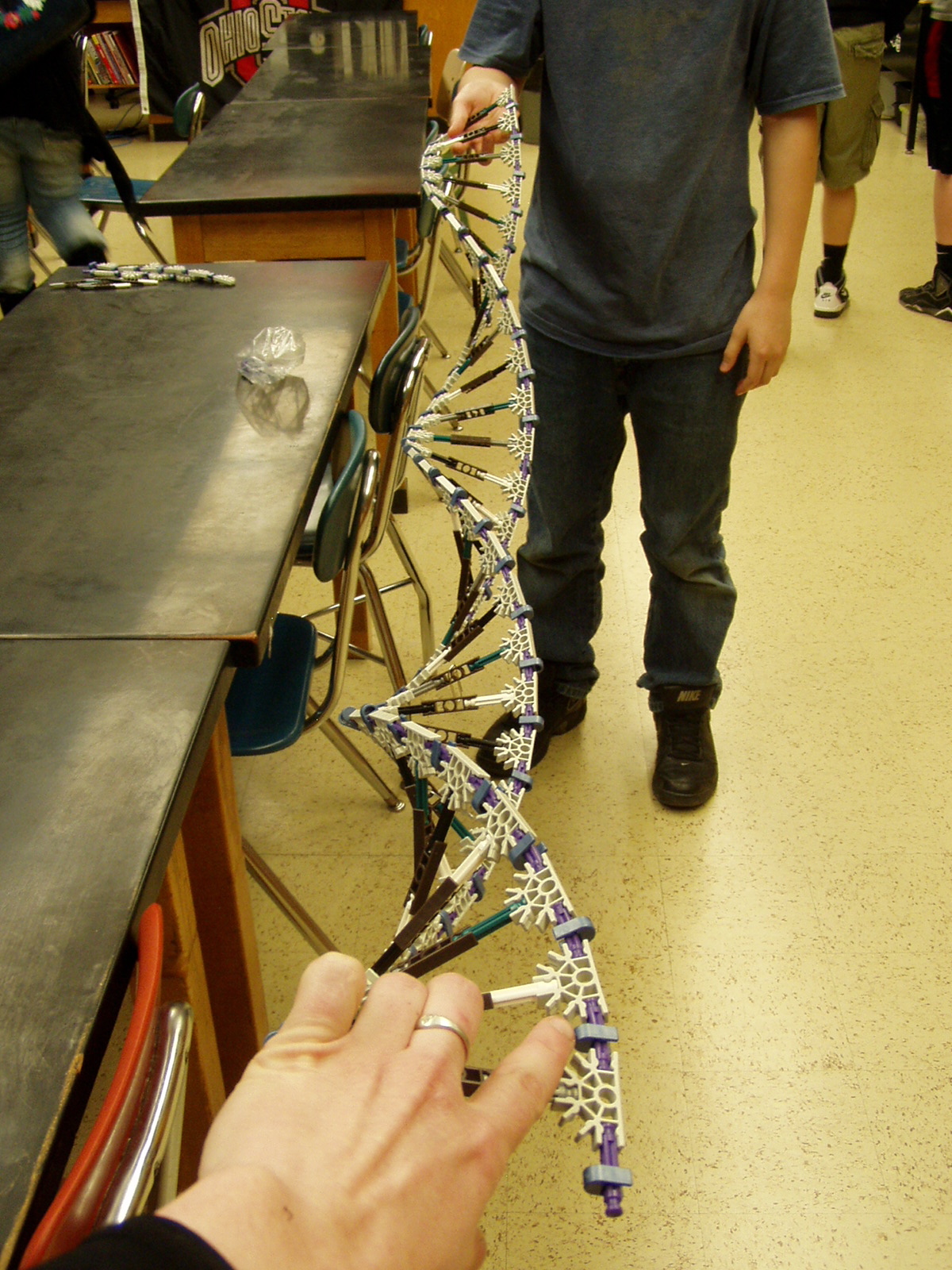
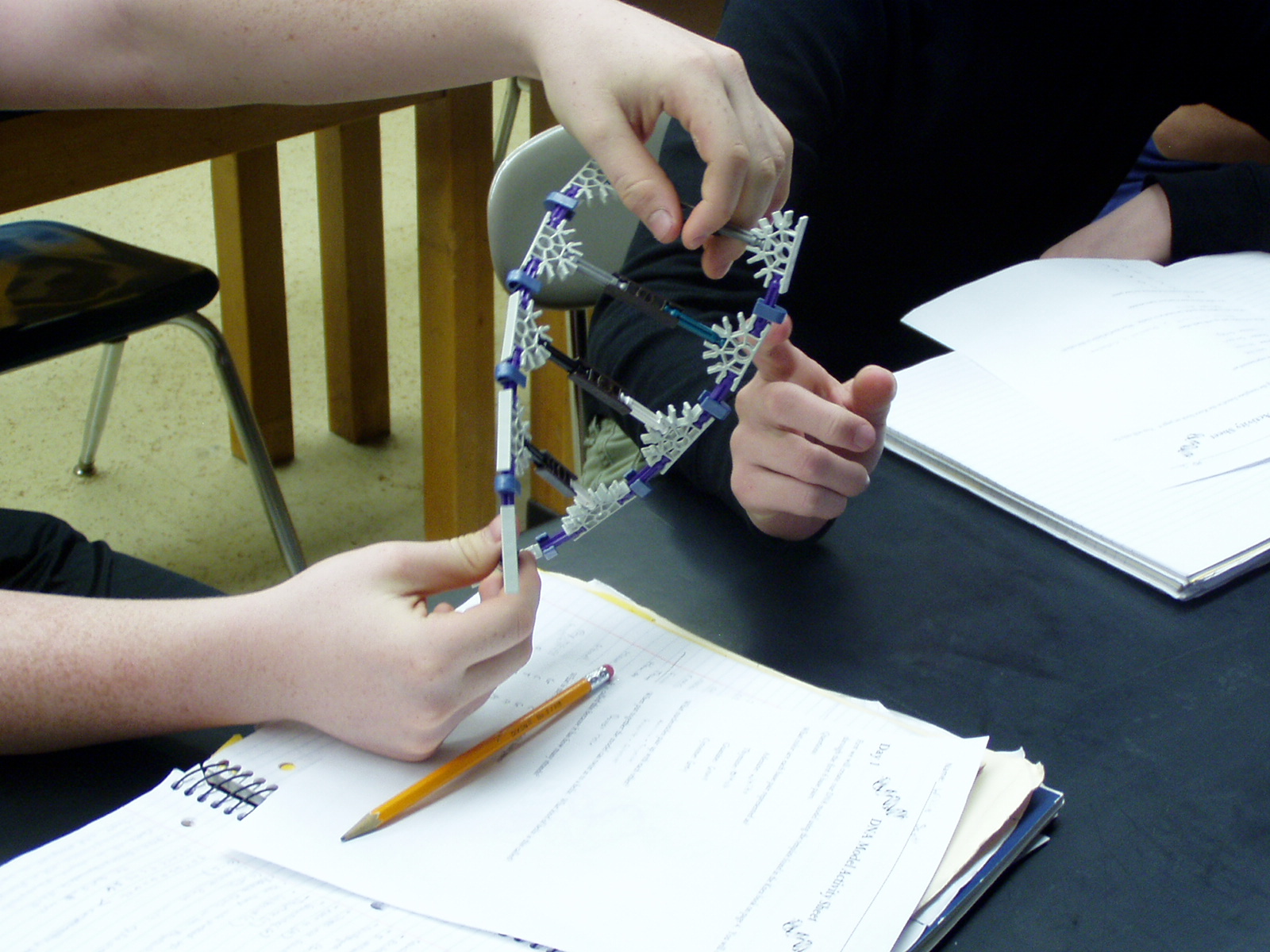
Today we started working with the Kinex DNA models. I gave you a bit of freedom in determining the DNA sequence, and we then made one big DNA molecule.
Only In Miss E's Room would you find boxes of DNA
Piecing it together
Tomorrow we will then act as DNA Helicase and DNA Polymerase as we go through DNA Replication.
Today's Daily Questions focused on points of replication
Thursday March 29th
How does Prokaryotic and Eukaryotic DNA replication
differ?
First, Prokaryotic cells have a single circular loop of DNA while Eukaryotic cells have many chromosomes. Because of this, the number of replication points will differ in prokaryotic and Eukaryotic cells.
How many points of replication do prokaryotic cells
have?
One point of replication (two replication forks will form)
About how many points of replication do eukaryotic
cells have?
Around 100 points of replication. If there was only one, as there is in prokaryotic cells, DNA replication would take over a MONTH!!!
By having more points of replication does DNA
replication happen slower or faster?
Speeds it up. With lots of replication points in eukaryotic DNA, replication only takes about 8 hours.
We have continued with our discussion on DNA structure and replication. Tuesday's daily question focused on DNA structure.
Tuesday March 27th
What
are the three main parts that DNA is made up of?
5 Carbon Sugar (Deoxiribose), A phosphate group, and a
nitrogenous Base.
How
do the 4 different nitrogenous bases pair up with each other?
Adenine with Thymine (A-T) and Guanine with Cytosine (G-C)
Given
the following Strand of DNA, please tell me what the complementary strand would
be.
ATTGGCTCGGA
TAACCGAGCCA
We then went through notes about DNA replication. (Check Edline for these)
Wednesday's set of daily question focused on DNA replication:
Wednesday March 28th
There are two enzymes involved in DNA
Replication. The first one DNA Helicase unwinds and “unzips” the double helix.
The second one DNA Polymerase adds new nucleotide
bases at the replication fork. It
also acts as a “Proof Reader”.
At the end of DNA replication we have two identical
DNA molecules. How are these two
molecules related? (this is the reason that DNA replication is known to be
“semi conservative) On original strand and one new strand
We then finished up the notes on DNA replication. My plan is to start working with the Kinex models tomorrow and Friday to go through making and replicating DNA.
There are a LOT of good websites available that will help you understand the structure of DNA. One of my favorites is The Genetics Science Learning Center put on by the University of Utah. This will lead you through a variety of activities in all aspects of DNA including Structure, Replication, Transcription and translation. Check it out!
Another is put on by PBS A Science Odyssey DNA Workshop. This also has interactive games that take you through transcription, translation and DNA replication.