Thursday, September 20, 2012

Steroids, Jello and Cow Bones Oh MY!


Thursday September 20th
Looking at the following chemical formula, what kind of biomolecule would you infer this to be?  Why?
               C19H28O2              
 This would be an example of a lipid.  You can tell by the large number of Carbons and Hydrogens.  While there is a FEW oxygen molecules - it is not anywhere CLOSE to a 1:2:1 ratio.  This is in fact the structural formula of Testosterone which is a natural steroid hormone found in our bodies.

Proteins have MANY different functions – in fact proteins are pretty much involved in ALL cellular functions in one way or another.  The structures of these proteins are incredibly complex.  First, what subunits make up protein? Amino Acids
Next, what determines the function of different proteins?  The shape and how those amino acids are folded on top of each other.

After this we continued through the notes focusing this time mostly on proteins.  We saw that the range of proteins is ENORMOUS.  I had you jot down a couple of the following examples and let you listen to a podcast about the source of the protein found in Jello.  Here a link to the transcript of that Podcast
Tomorrow I would like your "chemistry of Health" worksheet and writings.  We will also take a daily question quiz and finish up with organic molecules tomorrow.

Wednesday, September 19, 2012

Carbohydrates Vs Lipids

Yesterday we got through most of our discussion on Carbohydrates and that is why I based today's daily questions on that.

Wednesday September 19th

Carbohydrates are made up of what three elements in what ratio? Carbon, Hydrogen, Oxygen in a 1:2:1 Ratio (Remember, Carbohydrate literally means "Water" of Carbon, for every Carbon atom there is 2Hydrogen and 1Oxygen (H2O) )

What could you infer about a carbohydrate that has 12 Carbons (such as sucrose)'s chemical Formula?
That it would be C12H24O12 (1:2:1 ratio)  We see that in fact sucrose's chemical formula is ACTUALLY C12H22O11 due to how it all bonds together, which is CLOSE to the 1:2:1 ratio but that will not always be exact)

Other than a source of energy – what other function do carbohydrates have?
It acts as structural support to plants (in the form of cellulose) and certain insect's shells.
It also acts as a "name tag" attached to the cell membrane of EACH of our cells identifying which cell's in our body they are AND WHOSE they are (which is why organ transplants are so complicated!!!)

Which can store more energy Carbohydrates or lipids?
LIPIDS!!! Why?!?!  Take a look at the following two molecules
Lipid
Glucose

You can see there lipid molecules are made up of MANY more Carbon-Hydrogen bonds and energy is released when bonds are broken.  Because of this, lipids have the ability to STORE more energy - than carbohydrates but the problem is, it is harder to GET to that energy and our bodies will work through our glucose stores FIRST.

To put this in "real" terms I mentioned to you guys today about my upcoming marathon and how generally I hit the "wall" around mile 21 or so (it STARTS around mile 18 and progressively gets worse)  The BIOLOGICAL reason behind the "wall" is, at that point I have pretty much used up ALL my glucose stores and my body is breaking WHATEVER biological molecules it can apart in order to release energy.  Which means PROTEINS (like in my MUSCLES) are getting tore apart to get energy. THIS is kind of what mile 21 sometimes looks like (this was my FIRST marathon - they have got much better since then ;)  Here is a link that describes it in even more detail. http://www.marathonandbeyond.com/choices/latta.htm 
Mile 21 in my FIRST marathon

Mile 23 in the last marathon I ran (yep - sporting
my Ellwood Gear!!)


After this we continued through the notes on lipids and started into the differences between saturated and unsaturated fats.  We will hopefully be starting a activity on this stuff by friday.

Great Job today guys!!

Tuesday, September 18, 2012

Importance of Carbon and start discussing Carbs


Tuesday September 18th
Organic compounds that make us up are made up of many atoms of which element?  Carbon

Why is this element so useful in making macromolecules (large molecules)
It is relatively small - it is Kind (it likes to share it's electrons with many other atoms such as Hydrogen, Oxygen, other Carbon atoms and Nitrogen) and it can bond with up to FOUR other atoms at once.

How many valence electrons does this atom have that can be shared with other atoms?
4 - so therefore it wants to find other atoms that will fill that up (hence why it could bond with up to 4 other atoms)

The four primary biomolecules that make us up are:
Carbohydrates, Lipids, Proteins, Nucleic Acids

I had you guys watch the beginning of Hank Green's "Crash Course Biology" on Carbon.
Then we got through carbohydrates in the notes.  We will continue through these notes over the next couple days - remember - This friday we WILL have a daily question quiz!!!

Monday, September 17, 2012

Organic Molecules Introduction

First let's do a little catch up!!
Friday we did have the following daily questions
Friday September 14th 

Wednesday and Thursday of last week you guys didn't see me.  On Wednesday you got down all the notes for the next section and on Thursday you started into a supplemental reading from the National Institute of Health called "The chemistry of health".  This will help extend your knowledge of the chemistry of life that we have talked about into other areas such as "natures products" and pharmaceuticals.  

Water is able to resist drastic changes in temperature because it has a high Specific heat (heat capacity)

Why is this important to us? (As humans)
 Since we are made up of approximately 70-75% water, this fact allows us to minimize major temperature fluxuations in our body temperature.

Water is considered a "Universal Solvent"  This is because of how it disassociates when in solution. What two ions does water break into?
H+ (Hydrogen ion) and OH- (Hydroxide Ion)

Monday September 17th 
Using your “Chemistry of health” answer the following questions.

What is one importance of Fats (lipids) in our bodies?
They provide insulation, they are major sources of energy storage, they are a key part of the cell membrane as well as many others that we will be discussing in the next couple days.

What are sugars made up of? (it’s the reason carbohydrates are harder to make than proteins)
Saccharides (sugars)
What is the role of carbohydrates attached to the cell membrane?
They act as "name tags" identifying each cell (again - we will be talking about this in great depth over the next couple days and this specific example will be referred to when we learn about the cell membrane)

After going over these daily questions I had you guys talked a little about the molecule Capsaisin and told you my Jalapeno fingers story.  BEWARE!!!  Do NOT stick your fingers in your eyes after cutting up Jalapeno's!!  WHY???? Well take a look at the following molecule.

This "little" molecule is made up of a LONG change of Carbon and hydrogen. We will see in the next couple days that this is a very typical lipid molecule.  Here is the thing with Lipids - they are NON-polar, therefore the watery "saline" solution that is produced by our eyes (Also known as TEARS) will NOT break this down.  So therefore it will hang out in your eye for a while...... NOT a good time!   

Alright - after THAT fun story I had you guys watch one of the "Crash Courses" on Biological molecules.  I asked you to refer to the notes you have already taken and add any key ideas or terms you heard him describe.  We will be going through these notes together in class over the next couple days and I hope to get into a couple activities.  Half Day for you guys tomorrow!!


Tuesday, September 11, 2012

Finishing up Properties of Water


Tuesday September 11th


Water will form hydrogen bonds with other substances such as glass, soil and plant tissues. The term for this type of attraction is known as Adhesion

A combination of this and Cohesion can cause water to ‘defy gravity’ by moving UP narrow tubes (such as the roots of trees) in a process known as Capillary Action

**When we added soap to our pennies we were not able to get as much water on them – what do you think the soap did to the water? (Hint:  What causes cohesion)  The hydrogen bonds that hold water to each other are broke apart by the soap.  Because of this, the water is less "cohesive" and has a decreased surface tension.  This fact is why water alone is NOT a good cleaner since it really is just attracted to itself.  Once the hydrogen bonds are broken it is now able to be bond with other molecules to allow better "cleaning" (So wash your hands with water and SOAP otherwise you're not doing much cleaning!!!)

After this we continued through our notes on the properties of water.  You will continue through these tomorrow when I am out and then move into organic chemistry notes on Thursday.  Friday I will discuss all that you write down the two days I will be out.
Monday September 10th

 *Water can and WANTS to form bonds with how many other water molecules?
4
*Waters attraction to other water molecules is known as Cohesion

*The term for how water “pulls in” at the surface to form a “film” is known asSurface Tension


Friday, September 7, 2012

Cohesion and Surface Tension Activity

 After learning what cohesion and surface tension was - we started to see it in action.  Here's some pics on how it went.

Remember Cohesion is waters attraction to other water molecules.  It wants to bind with FOUR other water molecules.  At the SURFACE of the water there is no other water molecules ABOVE, so it holds tight to the what it can below!

First I had you fill the jar up to the VERY top
with water.
So that it was actually slightly
OVER the top of the Jar


Then you slowly added pennies
into the already full jar
They you saw how many would fit
before it overflowed.
You were able to really "see" how attracted water is to itself as you were able to put a lot of pennies into the jar.  Again, the key thing to remember is that this property of water is all due to the HYDROGEN BONDS holding them together.  Until the pressure from the pennies below is greater than the attraction to each other, they will remain bonded to each other.

Until then - a "film" forms on the top of water that can hold a bit of weight.  I then had you guys try and float a pin on top of the water to show the strength of these hydrogen bonds.


Wonders of water Day 2


Friday September 7th
Draw and label a water molecule 
What type of bond holds together this water molecule?
Because of this there are “partial” charges associated with it.  Which end acts +, which acts -? (Label those)

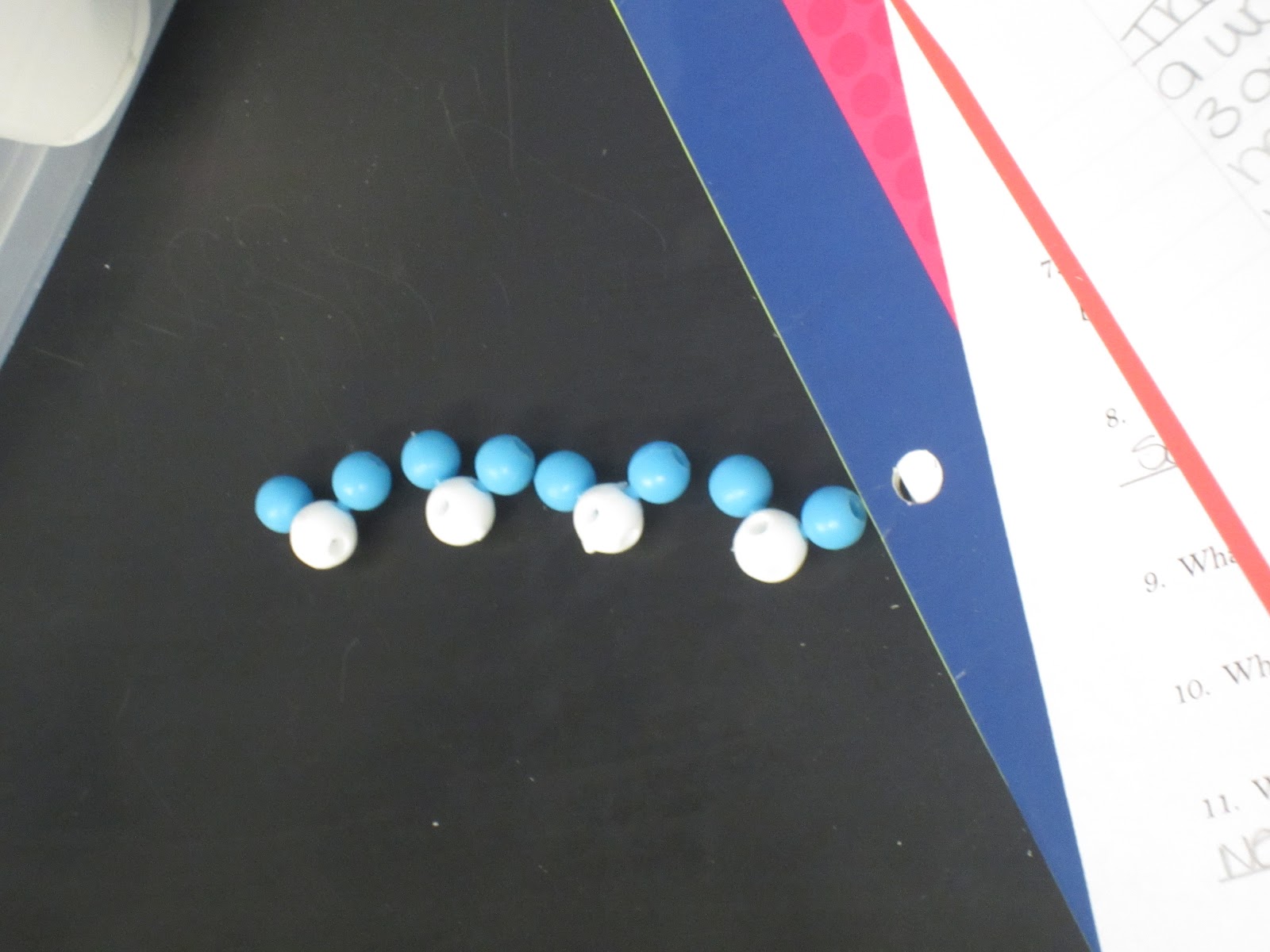
Using the models in your tubs – make 5 water molecules then place how you think 1 would bond with 4 others.
 What type of bond holds two water molecules together?

Your pop-it bead water molecules.  See how
the Hydrogens bond with oxygen and vice
versa - you will never see a Hydrogen bonded
with hydrogen of another water molecule.

Remember EACH of these would then be bonded to four Water
molecules which leads to a very complex crystal form


We then took one slide of notes on Cohesion and surface tension then got to see that in action!  Check the next blog post for pics on this activity.  (Remember - get notes off Edline if you are absent)

Thursday, September 6, 2012

Wonders of Water Day 1!!


Thursday September 6th


Based on this cartoon – What type of Bond is this “marriage” depicting?
An ionic bond since he is GIVING his electrons away.  Remember - I told you a way that I was taught to remember Ionic bonds is "I OWN it."  He GAVE her his electron so now she OWNS it!

What if instead the “boy” atom said “I do, Let’s share our valence electrons baby”  Which type of bond would it be referring to?
This would be a covalent bond.  Remember I told you that the prefix "co" means together, share or both.  In covalent bonds electrons are SHARED between two atoms.
-------------------------------------------------------------------------------------------------------------------------

After that we started into our discussion on water and its INCREDIBLY unique properties.  First I had you watch the following clip from the Waterboy.... WHY?!??!!  Because we are going to see that water does NOT suck and Gatoraide wouldn't have the effect it did if water wasn't the amazing molecule it IS!


We are in for some hands on stuff over the next couple days!!!
It may be hot in here - but we'll make the best of it :)


Then we started into notes about water.  Most classes got to the point of drawing out water molecules, seeing what makes it "polar" and then made some water molecules with pop-it beads.
Making water molecules out of pop-it beads

Note the "mickey mouse" shape of the water molecule.
This is due to the fact that water is held together by
POLAR Covalent bonds - so the electrons are shared
unevenly!!


4 perfect little water molecules!
Tomorrow we will see how they interact with each other

Youtube really CAN have great stuff on it!!

OK folks - You saw a bit of ONE of his videos, I think this guy is going to be my new partner in crime in terms of teaching you guys.  We at least seem to be on the same energy level that is for sure!!!!

Seriously though......check out some of these "Crash Courses" as we go through the year.  This nice thing about him over me is you can pause, rewind and fast forward him!!

Each one is between 10 - 15 minutes long and so far what I have seen is good stuff!!!


http://www.youtube.com/course?list=EC3EED4C1D684D3ADF 

Wednesday, September 5, 2012

When did we sign up for chemistry?!?!?!


Our nucleus prop
Not MUCH hapening - just a bunch
of protons and neutrons hanging out!!
Daily Questions Wednesday September 5th
The nucleus of an atom contains which subatomic particles? Protons and Neutrons


Of these two – which defines an element? Protons(remember - that is really the only real "EXCITING thing" about the proton is that it defines the element. Not much going on - I related it to the "couch potato" of the atom.

Watch out - you slack off in here and
an electron may come flying your way.
Gold has the atomic number 79. How many protons are in an atom of gold? How many electrons are there?
79 Protons and 79 Electrons (Remember - in an elecrtically neutral atom, the number of protons = the number of electrons)

Which part of an atom is important in bonding and determining the charge of an atom?
Electrons "The MUCH more exciting and 'electric' part of the atom!!"
An atom that has a charge is known as an Ion

How was this charge acquired? By the gaining or losing of Electrons

Today we continued through the notes on ions and in to bonding and an introduction to water. Most of the period we worked on the differences betwen ionic and covalent bonds.  The way I always remembered the difference between the two was that prefix "co" means together or both (for example, you guys have CO-Ed gym because the boys and girls SHARE the gym) just like in a Covalent bond electrons are SHARED.  In an ionic bond electrons are actually lost or gained.  So when one atom gains an electron it "owns it".  A way to remember this is "Ionic means "I OWN it"! 

I told you I would never make you learn something that I couldn't give you a reason WHY you should know it. That is why after the discussion on ions, I played the following pod cast on electrolytes. We will continue to see how this all plays a role in "life" as the chapter goes on!


THEN I gave you an introduction to what we will be discussing over the next two days.  This guy will tell you in about 11 minutes what we are going to discuss and DO in the next couple days!

Take a look!

Tuesday, September 4, 2012

Chemistry of life

The next part of this unit is on the chemistry of life.  I had you take a look at this picture to show how much chemistry interacts with all other areas of science.  EVERYTHING that happens in our bodies comes down to a chemical reaction.  This is why it is so important to get some of these basics down before we get into the complexities of life!

Today's daily questions were a review of what you learned in Physical Science.

Here they were:

Tuesday September 4th
Let’s see what you remember from physical science!!!
The smallest unit of matter is known as an Atom

Fill in the following table matching the parts of an atom with its charge

Part of atom
Charge
                   Proton
                  Positive
                  Neutron
                Neutral (No)
                   Electron
                 Negative
 After that we started into some notes on basic chemistry.  Please check edline for these - today we made it through the slides on bonds and will continue with these tomorrow!


Friday, August 31, 2012

We made it through our first FULL week!!! Nice job guys!!

As an extension to our lab from Wednesday - I had you see how yeast makes bread dough rise while you took your first Daily Question Quiz (DQ2) on the characteristics of life and proper experimentation.  After that we discussed a little more how microorganisms are used in creating different food products. For instance - ever wonder how swiss cheese gets the holes in it?

Check out this video!
Congratulations on making it through your first full week - Enjoy your Three day Weekend!!!

Thursday, August 30, 2012

Metabolism Lab Wrap up and Questions


The Daily Questions for today dealt with making a proper experiment and following the steps of the scientific method.  You have learned about the scientific method and proper experimentation by Mr.McConahy and/or Mr.Timmerman.  Because of this, I am not going to spend a ton of time teaching you this on its own, but during labs throughout the year we will revisit the importance of both of these.

Thursday August 30th

Yesterday we performed a controlled experiment.  Why do you think it was important that the ONLY thing we changed was the amount of sugar we fed the organism? (Each test tube had the same amount of yeast, same amount of water, the same color balloon, the same size test tube, etc.)
By only changing ONE variable, we can draw accurate conclusions.  If we changed both the amount of sugar AND the amount of yeast for instance, we would not be able to tell if the results we got were because of the sugar, or because there was more yeast.

“If we feed the yeast more sugar, then it will produce more waste”
This statement is an example of a:
A.  Theory  B.Experiment  C.Conclusion D.Hypothesis
This is a hypothesis because it can be tested.  A THEORY is something that has already been tested and proven true over and over.

The rest of the period I gave you guys time to answer the Lab questions and finish your note cards from yesterday.  

REMEMBER OUR FIRST DAILY QUESTION QUIZ IS TOMORROW!!!!

Wednesday, August 29, 2012

Metabolism Lab Progress

Starting to see metabolism at work!!
Test tube 2 and 4 seem to have some metabolic action
Test tube three is making it's way in there now!!
Now 4 fell over?!?!
What is up with that?
On closer examination - It is because if overflowed!!!


Close-up to metabolism in action
** Check out Edline for the pics of you guys actually performing the lab!!  Go to the "contents" part of Edline and click on "Characteristics of life pics"


Characteristics of life lab procedures

Each Group obtained a tube filled with 2 grams of living organisms.


Each tube of organisms got fed a different amount of "food"

We also gave the organism's 5ml of warm water

Put the organisms, the food and the water in the designated test tube, shake it up a bit


Put a balloon on top and see what happens!!!